
Tippah Court Records After Arrest
In Tippah County, the arrest to court path starts at the jail. The jail docket or roster captures the intake facts first: arrest charge, hold, bond, court row, warrant number, booking time, and the agency that brought the person in. Those records do not always match the final court record. They are the custody side of the event. Court records after a jail arrest begin to take shape when a judge holds an initial appearance, an affidavit is filed, a prosecutor reviews the matter, or a Circuit Court case is opened.
The official Tippah County courts page gives an unusually specific local rule for felony arrests. It says all felony cases are first heard in Justice Court for initial appearance and affidavit filing, and that Justice Court judges hold court sessions at the jail three times each week so each person has an initial court appearance within three days of arrest. For the roster and booking side, use Tippah County jail inmate records. For booking photos, use Tippah County jail mugshots. The court record is the charge file, hearing history, disposition, and judgment record that follows the arrest.
The official Tippah County courts page shows the local court offices tied to jail arrests.
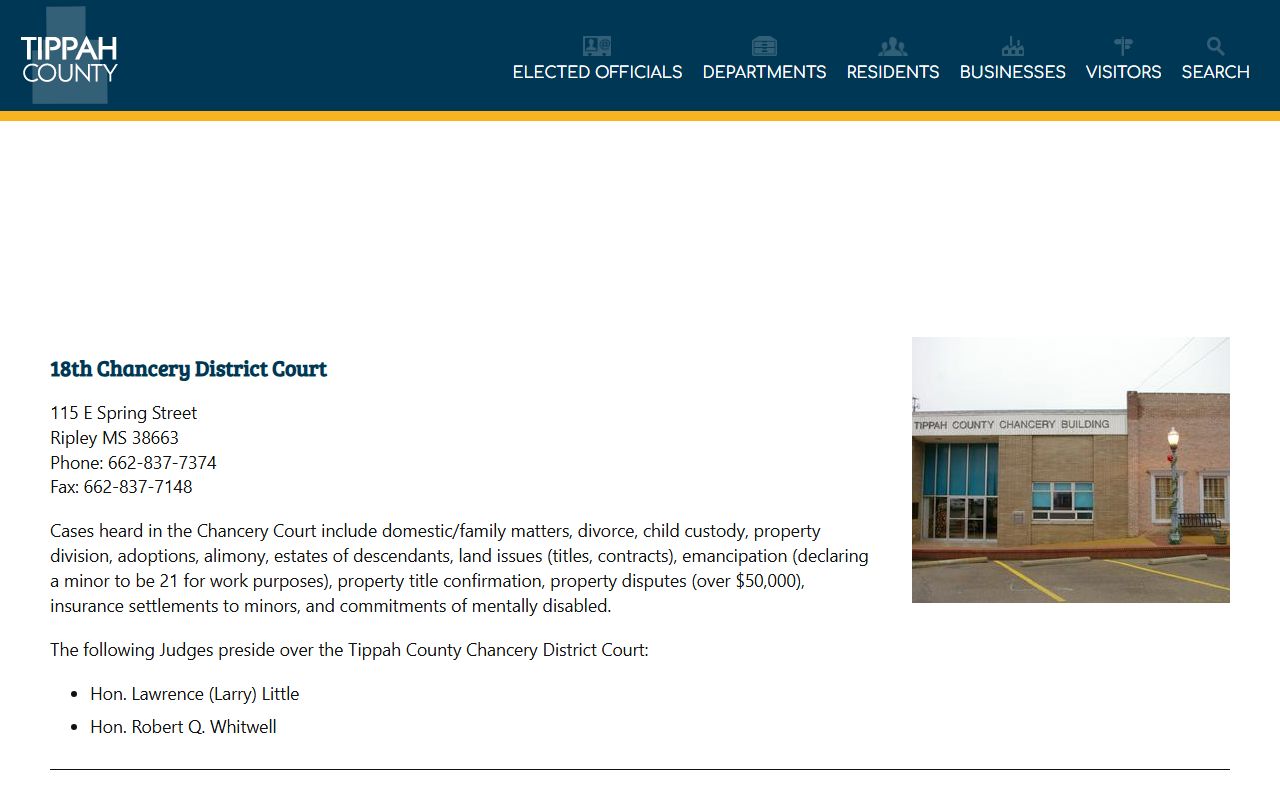
That court page is the local source for Justice Court, Circuit Court, the county prosecutor, the district attorney, and the jail initial-appearance schedule.
Find Tippah Court Records
Filed felony court records are usually checked through the Circuit Clerk or the subscription court portal after the first jail and Justice Court stage. Tippah County uses Delta Computer Systems for the visible "Criminal Court Cases Link, Tippah County, MS." The portal states that Circuit Court records are available from 2008 to present with images, judgments from 2008 to present with images, and marriage licenses from 2012 to present without images. Full access requires a paid account, so a person who only needs to confirm the right office can still use the visible search fields to understand how the index is organized.
- Start with the sheriff or jail record to confirm the booking name, arrest date, bond row, court row, and next court date.
- Match the court row to the right forum: Justice Court, Circuit Court, Ripley Municipal City Court, Walnut Municipal Court, Drug Court, Chancery Court, or another listed court.
- Use the Delta Computer Systems Tippah criminal case search or the Circuit Clerk for felony Circuit Court filings.
- Use Justice Court for initial felony affidavits, DUIs, county ordinance matters, MHP tickets, TCSO tickets, and lower-court ticket rows.
- Use the applicable municipal court when the jail row points to Ripley or Walnut municipal charges.
The search path matters because a jail booking charge may not be the filed charge. A prosecutor can amend, reduce, dismiss, indict, decline, or present charges to a grand jury after booking. A person can also stay in jail because of a hold, detainer, or warrant from another agency even when one local charge appears bondable.
The Delta criminal court portal displays the Tippah County case-search fields and subscription notice before full case access.
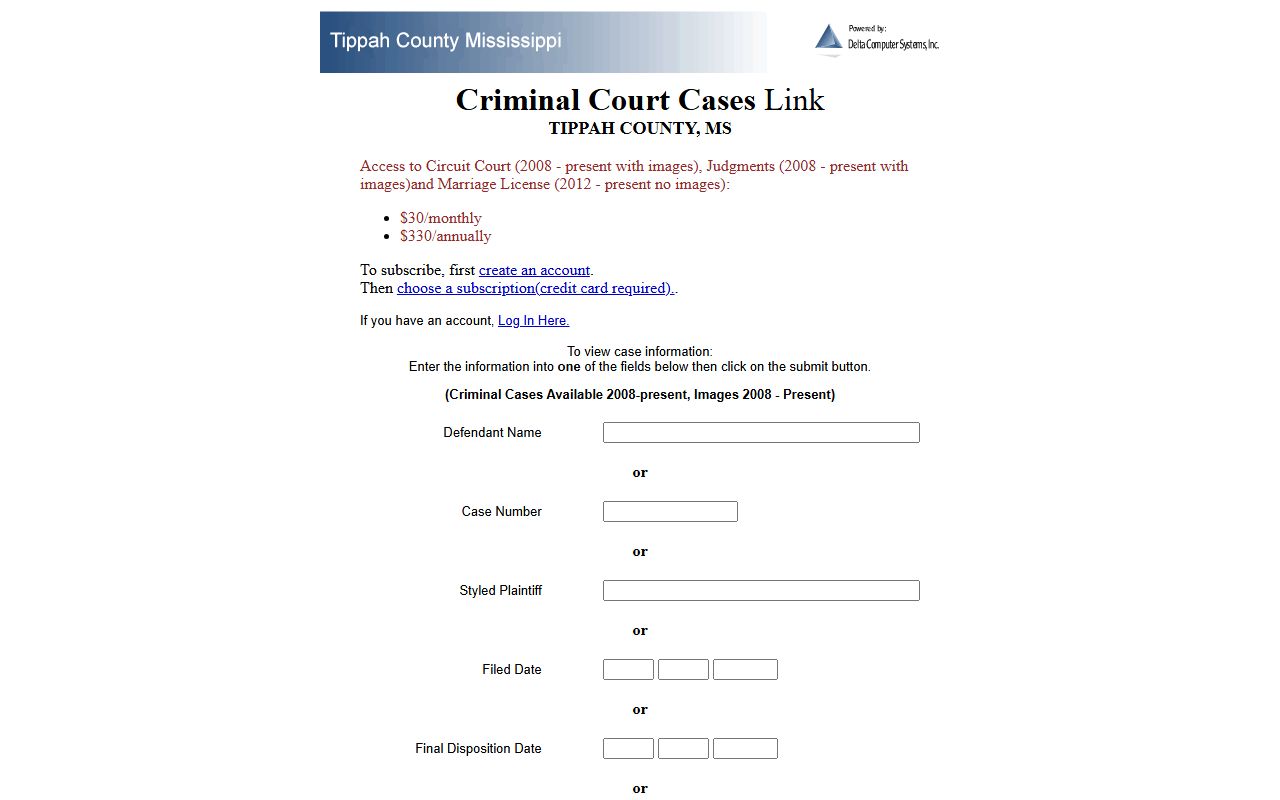
The portal is most useful once a Circuit Court case number, defendant name, filing date, or final disposition date is known.
Tippah Court Search Fields
The Delta portal's visible form is a practical map of how Tippah County court records after an arrest can be searched. The form does not replace the jail docket, and it does not prove that a person is in current custody. It is aimed at court cases, which means the search becomes stronger after a charge has been filed and indexed. When the search returns no case, check spelling, date range, and whether the matter is still in Justice Court or municipal court.
| Field | Type | Use |
|---|---|---|
| Defendant Name | Text | Search by the arrested person's name as it may appear in the court file. |
| Case Number | Text | Best when the Circuit Clerk, court notice, or docket row provides a case number. |
| Styled Plaintiff | Text | Search by caption language when the plaintiff side is known. |
| Filed Date | Date | Useful when the filing date is known after arrest or indictment. |
| Final Disposition Date | Date | Used after plea, verdict, dismissal, or other final action. |
| Docket (Book/Page) | Text | Search by docket book and page when older indexing data is available. |
| File Number | Text | Search by assigned file number from the clerk or court paperwork. |
| Party Name | Text | Broader name search for parties tied to the record. |
| Refinements | Radio and date range | Use Yes or No, filing date from and to, and Case Type All, Civil, or Criminal. |
Delta lists a monthly subscription price of $30 and an annual price of $330. For people who do not need image access, the Circuit Clerk can still identify the correct filing route for criminal case records.
Tippah Arrest Court Offices
Justice Court is the first court named by the county for felony initial appearances and affidavit filing. It is listed at 205-B West Spring Street in Ripley, with phone 662-837-8842 and fax 662-837-1398. The county page names Hon. Benny Jackson for the North district and Hon. Sonny Meeks for the South district. Justice Court also handles DUIs, county ordinances, Mississippi Highway Patrol tickets, and Tippah County Sheriff's Department tickets. That makes it the key lower court when a jail row shows an initial appearance, affidavit, DUI, ordinance charge, or local ticket.
Circuit Court District 3 is listed at the Tippah County Courthouse, 102-A North Main Street in Ripley, with phone 662-837-7370 and fax 662-837-1030. Circuit Court has original jurisdiction over civil and criminal matters not placed exclusively in another court. Tippah County lists Hon. J. Kelly Luther, Hon. Gray Tollison, and Hon. Kent Smith as Circuit judges. The Circuit Clerk, Phil Koon, is at the Tippah County Administration Building, 101 E Spring Street, 1st Floor, Ripley. The Circuit Clerk page describes criminal and civil filing duties, which is why felony case files and criminal-history record questions route there.
Note: The court row on a jail roster should control the next call, not just the arresting agency name.
Tippah Charging Documents
After a Tippah County arrest, a charge can enter the court system through more than one kind of document. The local courts page specifically ties felony first appearances to Justice Court affidavits. A later felony case may move into Circuit Court through grand jury action or another formal filing. Misdemeanors, DUIs, ordinance cases, and tickets may stay in Justice Court or municipal court depending on the court row. The label matters because each document tells a different story about where the case is in the process.
| Document | What It Does | Typical Tippah Use | Where to Ask |
|---|---|---|---|
| Complaint or Affidavit | Starts a sworn lower-court charge or felony preliminary matter. | Felony initial appearances, DUIs, ordinances, MHP or TCSO tickets. | Justice Court or the court named on the jail row. |
| Information | Prosecutor-filed charge used when allowed by procedure. | Formal charge filing after prosecutor review. | Circuit Clerk or prosecutor, depending on stage. |
| Indictment | Grand jury charge that moves a felony into Circuit Court. | Serious felony prosecution after grand jury presentation. | Circuit Clerk, Circuit Court, county prosecutor, or district attorney. |
The County Prosecuting Attorney, Bart Adams, represents the state in felony matters before justice or county court, criminal appeals from those courts to Circuit Court, and matters that may be presented to the grand jury. The 3rd District Attorney is Ben Creekmore, and the DA profile page lists Thad Mueller as an Assistant District Attorney for Tippah Counties. Those prosecutor roles explain why the first booking charge is not always the same as the filed court charge.
Tippah Charge Status Records
Charge status is the current condition of a filed or listed charge. A jail row may show a bond amount, bond status, court name, warrant number, and charge type such as felony or misdemeanor shorthand. A court record may later show that the charge is pending, amended, reduced, dismissed, sent to a grand jury, resolved by plea, or resolved by trial. The safest reading is to treat jail data as the arrest and custody snapshot, then use the court file for the formal case status.
| Status | What It Means | What to Check Next |
|---|---|---|
| Pending | The charge has not reached final disposition. | Next court date, bond order, attorney notice, or docket setting. |
| Amended or Reduced | The filed charge changed from the original booking or complaint label. | Prosecutor filing, court minutes, or amended charge document. |
| Dismissed | The court ended that charge without a conviction on that count. | Dismissal order, expunction eligibility, and any remaining counts. |
| Declined or No Billed | The prosecutor or grand jury did not proceed on that charge. | Clerk status and whether related charges remain active. |
| Convicted | A plea, verdict, or judgment resulted in conviction. | Sentence, jail credit, probation, MDOC transfer, or appeal deadline. |
Tippah Bond Court Records
Bond in Tippah County is tied to the court that controls the charge. The jail roster PDF showed total bond fields and per-charge bond rows, including $0.00 holds and larger bond amounts on Circuit Court rows. It also showed labels such as hold for probation officer, MDOC hold, hold for investigator, hold for judge, other-agency hold, and out-of-state hold. Those labels can matter more than the dollar amount. A person with a listed bond may still not be released if a no-bond hold, detainer, or another court order controls custody.
| Bond Type | How It Works | Tippah Checkpoint |
|---|---|---|
| Cash Bond | Money is paid directly when the court allows cash release. | Call the jail or the court named on the charge row before bringing funds. |
| Surety Bond | A commercial bail agent posts bond if the charge permits it. | Confirm that no hold blocks release. |
| Personal Recognizance | The judge releases the person on a promise to appear. | Check the court order and next court date. |
| No-Bond Hold | Payment will not release the person because a hold or order controls custody. | Ask whether MDOC, another county, a judge, or a warrant is the source. |
The Mississippi Rules of Criminal Procedure govern initial appearance and release procedure. Locally, Tippah County's Justice Court schedule at the jail is the practical fact that connects an arrest to the first court review.
Tippah Warrant Court Records
No official Tippah County active warrant search page was located. That does not mean warrant data is absent from local records. The jail roster PDF included warrant numbers and hold labels, which shows that warrants and detainers can appear once a person is booked. For an active warrant question, start with the sheriff or jail at 662-837-9336, then call Justice Court at 662-837-8842 for lower-court warrants or Circuit Clerk and Circuit Court at 662-837-7370 for felony, capias, indictment, or Circuit bench-warrant issues.
Municipal rows matter too. Ripley Municipal City Court and Walnut Municipal Court appeared in roster records, so a municipal bench warrant may not be resolved through a county court page alone. MDOC Probation and Parole should be used for supervision holds only, not as a general warrant clearing office. VINE, MDOC, BOP, and ICE can help confirm custody after a booking or transfer, but they do not replace the court that issued the warrant.
Tippah Charges vs Convictions
A charge is an accusation. A conviction is a final outcome from a plea, verdict, or judgment. Tippah County court records after a jail arrest can show both, but they should not be treated as the same thing. Booking data may reflect what officers entered at intake. Filed charge data reflects what the prosecutor or court pursued. Conviction data reflects the final outcome on a count after due process.
| Point | Charge | Conviction |
|---|---|---|
| Stage | Begins as an accusation after arrest, affidavit, information, or indictment. | Comes after a guilty plea, verdict, or judgment. |
| Proof Level | Can begin with probable cause or a sworn complaint. | Requires proof beyond a reasonable doubt or a valid plea. |
| Record Meaning | Shows what was alleged or filed. | Shows the legal outcome on that charge. |
| Can Change | May be amended, reduced, dismissed, or declined. | May lead to sentence, probation, appeal, or eligible post-case relief. |
Tippah Sealed Expunged Records
Mississippi law treats access to criminal and jail records as public unless a rule, statute, order, or exemption limits release. The Mississippi Public Records Act supplies the public-access framework, while Section 25-61-5 covers public-body access procedures and response duties. Section 25-61-7 allows reasonable fees for searching, reviewing, duplicating, and mailing records. For jail custody facts, Section 19-25-63 requires the sheriff to keep a jail docket.
Expunction is different from normal public access. Mississippi Code 99-19-71 allows eligible expunction for certain dismissed, dropped, no-disposition, not-guilty, and qualifying conviction cases. A court order is the key event. Until an order applies, the record may remain available through the office that keeps it.
| Point | Sealed | Expunged |
|---|---|---|
| Public View | Hidden from ordinary public access by court rule or order. | Removed or treated as cleared under the expunction order. |
| Record Holder | The office may retain restricted access for allowed uses. | Agencies follow the court's expunction command for covered records. |
| Eligibility | Depends on the type of case, order, and confidentiality rule. | Depends on Mississippi Code 99-19-71 and the exact disposition. |
| Best Proof | Sealing order or docket entry. | Signed expunction order and clerk confirmation. |
Restricted Tippah Court Records
Some court records after a jail arrest may be limited even when a booking occurred. Juvenile matters, sealed cases, expunged cases, active-investigation material, protected victim information, confidential supervision material, and records under a specific court order may not be released in full. A denial should not end the request. Ask the office to cite the exemption and to provide any nonexempt parts that can be released with redactions.
For filed criminal cases, the county's own FAQ routes criminal-history and civil-litigation questions to the Circuit Clerk. For jail docket or booking records, the sheriff is the starting point because the sheriff operates the jail and keeps the jail docket. For state-prison records after sentencing, use MDOC. For federal or immigration custody after transfer, use BOP or ICE. Keeping those systems separate avoids false negatives and wrong-office delays.
Important: Public court or jail lookups are not FCRA consumer reports and should not be used for employment, credit, insurance, or tenant screening.